
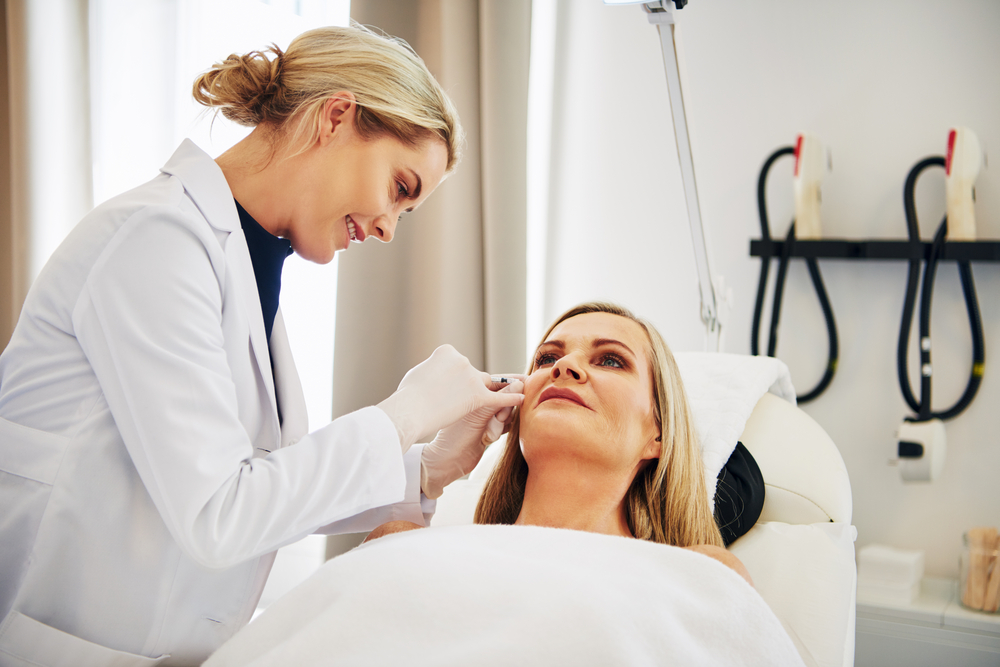
Two questions come up most at consultations for wrinkle relaxers in Jacksonville, FL: when does Botox start working, and is it too early or too late to start? Both are fair questions with specific answers. Botox starts working within days, but peak results take two weeks. The best age to start depends less on a number and more on what your skin is doing right now. This guide covers both, so you leave with a clear picture instead of a vague "it depends."
All botulinum toxin products carry an FDA Boxed Warning about the potential for toxin effects to spread beyond the injection site. At cosmetic doses, this is rare, but your provider will review this with you before treatment.
What does this article cover?
- When Botox starts working and what a realistic day-by-day onset looks like
- What is the best age to get Botox, actually, in clinical terms
- How starting in your 30s differs from starting in your 40s
- What Jacksonville, FL, residents should know before booking a first appointment
Key takeaways
- Botox starts working within 3 to 7 days for most patients, with peak results visible at day 14.
- The best age to get Botox is not a fixed number. It is when dynamic lines begin to remain visible at rest, which often occurs in the late 20s to mid-30s.
- Starting Botox earlier (preventive use in the 30s) requires fewer units and less frequent treatment than corrective use in the 40s.
- Results typically last 3 to 4 months regardless of age, though first-time patients often see results wear off slightly faster as muscles adjust.
When does Botox start working? A day-by-day breakdown
Botox does not work instantly. It works by blocking the nerve signals that tell facial muscles to contract. That process takes time to unfold at the cellular level.
Most patients notice subtle changes within 3 to 4 days. Movement in the treated area starts to feel different before the visual result appears. By days 5 to 7, the smoothing effect becomes visible.
Most patients notice the first subtle changes between days 3 and 7. The American Academy of Dermatology states that most people see results within 3 to 7 days of treatment, with effects lasting around 3 to 4 months. (Botulinum toxin therapy: overview, American Academy of Dermatology) Full results settle in by day 14, which is the right point to assess whether any minor touch-up is needed.

Botox onset timeline at a glance
What is the best age to get Botox?
The best age to get Botox is not 30 or 40. It is the age at which your specific skin shows the first signs that preventive or corrective treatment will be effective.
For most people, that window opens in the late 20s to early 30s. Fine lines from squinting, smiling, or raising the brows. The fullness to linger a few seconds after the expression ends. That is the clinical signal. A line that disappears immediately is not ready for treatment. A line that takes three to five seconds to fade is.
Some patients in their 20s with strong facial muscle activity and sun-heavy skin may benefit from starting earlier. Others with naturally resilient skin may not see a practical reason to start until their late 30s. The skin tells the timeline, not the birthdate.
Botox in your 30s: what preventive treatment actually looks like
Starting Botox in your 30s is not about correcting deep lines. It is about slowing their formation. When a muscle cannot contract fully, it cannot etch a crease into the skin above it.
Most patients in their 30s use smaller doses. The treated muscles are still relatively untrained, so fewer units are needed to produce a clear result. Treatment intervals often stretch to 4 to 5 months because the baseline muscle activity is lower.
The areas most relevant in the 30s are:
- Forehead horizontal lines
- Glabellar lines (the 11s between the brows)
- Crow's feet at the outer corners of the eyes
Patients who start in their 30s and maintain consistent treatment tend to show less visible aging in their 40s because the repeated muscle relaxation prevents the deeper creasing that forms over years of uninterrupted contraction.
Botox in your 40s: corrective vs. preventive goals shift
By the 40s, most lines have moved from dynamic (only visible during expression) to static (visible even at rest). That changes how Botox is used and what it can reasonably achieve.
Static lines respond less dramatically to Botox alone. Botox still relaxes the muscle driving the crease. Still, an etched-in line at rest may require a combination approach, sometimes including a dermal filler, to address the underlying volume loss.
Patients starting Botox for the first time in their 40s often require slightly higher unit counts because their muscles are more stretched and the correction goal is greater. Results are still clear and natural-looking. The expectations just need to be calibrated to corrective rather than preventive outcomes.
Starting in your 40s is not too late. It is simply a different clinical conversation.
Expert tip: requires time; patients sometimes expect results at day three and feel disappointed when they're not there yet. The two-week window is real. Results on day five are not final. Give it the full 14 days before deciding whether a touch-up is needed. Coming back too early often leads to over-treating an area that just needed more time."
If you are in Jacksonville, FL, and trying to figure out whether your skin is at the preventive or corrective stage, book a consultation at New Day Medspa, where licensed ARNPs and PAs assess your specific lines, muscle activity, and skin quality before recommending any treatment.
How does age affect how long Botox lasts?
Botox does not last longer just because you started earlier. Duration depends on metabolism, muscle strength, and the units used, not age alone.
First-time patients at any age often notice results fading slightly faster, around 2 to 3 months, because the muscles have not yet experienced repeated relaxation cycles. After two to three consistent treatments, most patients settle into a 3- to 4-month duration.
Patients in their 40s with stronger, more active facial muscles may find that Botox is metabolized slightly faster than in those with lighter muscle activity. This is one reason unit counts and injection placement need to be recalibrated with each appointment, not just repeated automatically.
30s vs. 40s: what changes between the two decades
About New Day Medspa
New Day Medspa is a medically guided aesthetic practice in Jacksonville, FL. All wrinkle relaxer treatments are performed by licensed ARNPs and PAs who assess your current line patterns, muscle activity, and skin quality before recommending a treatment plan. Every new patient receives a complimentary consultation so the approach fits your skin, not a standard protocol.
Suggested articles
- How long does it take for Botox to work? A day-by-day breakdown goes deeper into the onset timeline and the factors that affect how quickly results appear; it is the natural companion to this age-focused guide.
- How many units of Botox do you need for your forehead? covers real unit ranges by treatment area, which directly connects to why the dose needs to shift between the 30s and 40s.
- How much is Botox in Jacksonville, FL? A 2026 price breakdown answers the cost question that follows naturally once someone decides which age-based approach fits them.





.svg)