
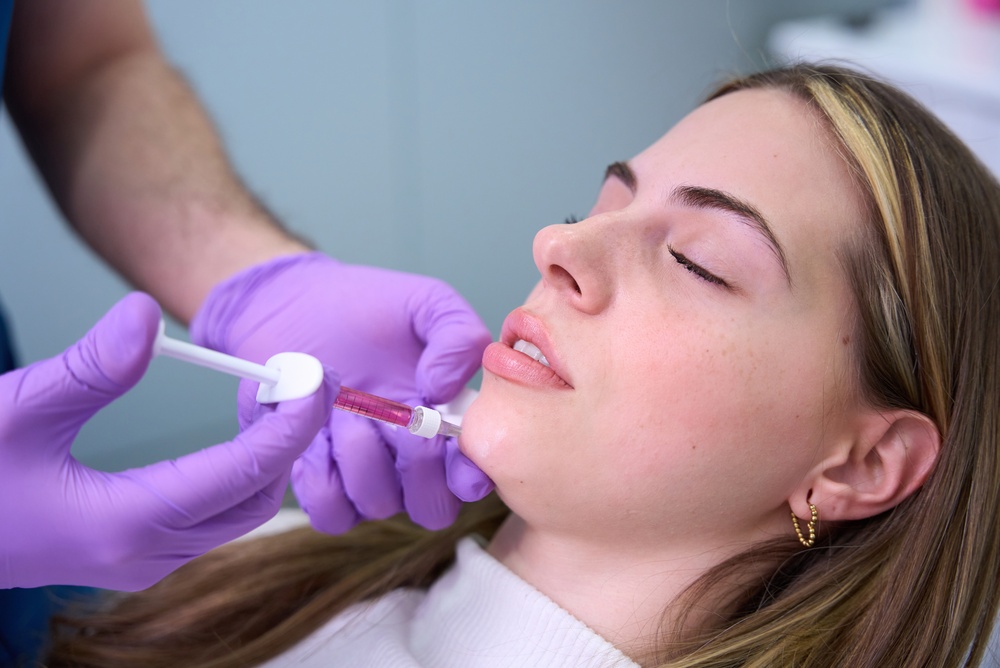
Most people researching facial fillers for the first time run into the same problem: the information either assumes you already know what a filler is or jumps straight to specific products without explaining the basics. This guide starts from the beginning. It covers what facial fillers are, how they work inside the skin, what the different types do, which areas they treat, and what a realistic first experience looks like, from consultation through results.
What Does This Article Cover?
- What facial fillers are and how they work at a biological level
- The main types of facial fillers and what each is designed to treat
- Which facial areas fillers address and what changes in each zone
- What to expect at a first facial filler consultation at New Day Medspa in Jacksonville
Key Takeaways
- Facial fillers are injectable gels placed beneath the skin to add volume, restore structure, or smooth lines in specific facial zones. They are not the same as Botox, which relaxes muscles.
- The FDA has cleared multiple categories of dermal fillers for cosmetic use in the US. Hyaluronic acid is the most widely used type and the only category that can be dissolved with an enzyme if you need to adjust the results.
- Most facial filler results are visible immediately and last 6 to 18 months depending on the product used and the treatment area.
- Dermal fillers at New Day Medspa in Jacksonville start at $499 per area with financing through Cherry, PatientFi, Afterpay, and Klarna.
What Are Facial Fillers?
A facial filler is a gel substance injected beneath the skin to add volume where it is placed. The gel sits in the tissue and physically fills the space, which changes the contour, depth, or fullness of the treated area from the outside.
That is the core mechanism. Where it goes and how deep it goes determine what it does.
Placed in the cheeks, filler lifts and adds projection to the midface. Placed along the jawline, it sharpens the lower face border. Placed in the lips, it adds visible volume and definition. Placed at the chin, it improves forward projection and profile balance. In each case, the result is structural: filler changes shape by adding physical gel beneath the surface.
Fillers are not Botox. This distinction matters because people often mention the two together, and new patients sometimes assume they're the same thing. Botox is a neurotoxin that relaxes specific facial muscles to reduce expression-related wrinkles. Fillers are gels that add volume. They treat different concerns, work through different mechanisms, and are often used in combination because they complement each other rather than overlap.

How Do Facial Fillers Work?
A fine needle or cannula injects the gel into the subcutaneous tissue beneath the skin. Where the product lands depends on the treatment goal. Structural zones like the cheeks and jawline receive filler deeper, closer to the bone, to provide lift and projection. Softer zones like the lips and nasolabial folds receive filler at a more superficial level to add volume and smooth surface lines.
Once placed, the gel integrates with the surrounding tissue. Hyaluronic acid fillers, the most commonly used type, attract and retain water, which adds to the volume effect and keeps the area hydrated. The gel holds its shape for months before the body gradually metabolizes it through natural enzymatic processes.
The body does not reject properly placed hyaluronic acid filler because hyaluronic acid is a substance the body already produces naturally. It is present in skin, connective tissue, and synovial fluid. The injected version is a cross-linked, stabilized form designed to hold its structure longer than the naturally occurring molecule.
What Types of Facial Fillers Are There?
The FDA has approved dermal fillers for adults 22 years of age or older for specific cosmetic indications, including augmenting the lips, cheeks, and chin, as well as correcting moderate to severe facial wrinkles and skin folds. The FDA distinguishes between absorbable (temporary) fillers, which the body metabolizes over time, and non-absorbable (permanent) fillers, which remain in place indefinitely. (U.S. Food and Drug Administration, Dermal Fillers)
Hyaluronic Acid (HA) Fillers
The most widely used type. HA fillers are cross-linked hyaluronic acid gels formulated at different densities and viscosities for different facial zones. Thicker, firmer HA gels sit deeper in structural zones like the cheeks and jawline. Softer HA gels work better in mobile zones like the lips.
The defining advantage of HA over all other filler types: it is reversible. An enzyme called hyaluronidase dissolves HA filler within 24 to 48 hours if you need to adjust or reverse the result. No other filler type offers this option.
Duration: 6 to 18 months depending on the product and treatment zone. Lips metabolize filler faster because of constant movement. Cheeks and jawline hold results longer.
Calcium Hydroxylapatite (CaHA)
A denser, more structured filler that also stimulates collagen production over time. CaHA is used for deeper structural corrections in areas like the cheeks and chin, as well as for hand rejuvenation. Results are not reversible with an enzyme. Duration: 12 to 18 months.
Poly-L-Lactic Acid (PLLA)
This type does not add immediate visible volume. Instead, it acts as a biostimulator, triggering the body's own collagen production over three to six months. Results build gradually. PLLA is used for diffuse volume restoration across multiple facial zones rather than targeted structural correction. Duration: up to two years.
Facial Filler Types at a Glance
New Day Medspa specializes in hyaluronic acid (HA) fillers from the Juvéderm line. The other categories are covered here for completeness; your provider can advise whether an HA filler suits your goals or whether another product type, available elsewhere, is a better fit
What Areas Do Facial Fillers Treat?
Fillers are not a one-size treatment. Different zones of the face have different structural needs, and the product and placement depth change depending on what you are treating.
Cheeks: Volume restoration in the midface is one of the most common filler goals. As facial fat pads thin and descend with age, the cheeks flatten, and the face can appear tired or drawn. Filler placed at or near the cheekbone level restores projection, lifts the midface, and indirectly softens nasolabial folds by supporting the tissue above them.
Lips: HA fillers in the lips add physical volume and can define the border, improve symmetry, or restore volume lost to aging. First-time patients typically start with half a syringe to one full syringe for a natural result.
Jawline: Filler along the mandible defines the angle between the jaw and neck, sharpens the lower face border, and reduces the appearance of early jowling. We use high G-prime products that hold their shape under mechanical stress.
Chin: Chin filler adds forward projection, improves profile balance, and strengthens lower-face structure. For patients with a recessed chin, the improvement in facial proportion can be significant.
Nasolabial folds: The lines running from the nose to the corners of the mouth. Filler softens these by adding volume beneath them, though mid-face volume restoration often addresses them indirectly.
Expert tip: Before any facial filler consultation, take three photos of your face: straight on, left profile, right profile. Bring all three. The frontal view shows symmetry and the overall face shape. The profile views reveal chin projection, midface depth, and the relationship between the nose, lips, and chin that the frontal view completely hides. A provider who reviews all three views before discussing placement builds a treatment plan around your full facial structure, not just what shows in a selfie.
If you're in Jacksonville and want to talk through what facial fillers could do for your face, book a complimentary consultation at New Day Medspa at 6817 Southpoint Parkway, Suite 2501. A licensed ARNP or PA assesses your facial structure from multiple angles before recommending any product, volume, or placement.
What Does Getting Facial Fillers Feel Like?
The appointment typically runs 30 to 45 minutes for a new patient, including the topical numbing application time.
Numbing: The provider applies a topical numbing cream to the treatment area and leaves it on for 10 to 15 minutes. Most HA fillers also contain lidocaine, which provides additional comfort during injection.
The injections: The provider uses a fine needle or cannula to place the filler in the planned zones. Multiple small injections or passes build the volume systematically. The provider pauses between zones to assess the result and adjust placement as needed.
Immediately after: Swelling is normal. The day-of result includes both the genuine filler effect and post-injection swelling, so what you see immediately is larger and slightly different in character than the settled result.
Day 10 to 14: Swelling has resolved. The product has integrated with the surrounding tissue. What you see now is the actual result. This is the right time to compare against your baseline photos and assess whether any adjustment is needed.
What Do Facial Fillers Cost in Jacksonville?
Facial fillers at New Day Medspa start at $499 per area. Common treatment areas and typical starting costs:
Financing is available through Cherry, PatientFi, Afterpay, and Klarna. Your provider will recommend a specific volume and total cost at the complimentary consultation, based on your facial anatomy and goals.
Are Facial Fillers Safe?
Hyaluronic acid fillers have a well-established safety record built on decades of clinical use and peer-reviewed research. The most common side effects are temporary: swelling, redness, and mild tenderness at injection sites, typically resolving within a few days.
Serious complications are rare when a qualified provider uses FDA-cleared products. The most clinically significant risk is vascular occlusion, a rare event where filler is inadvertently placed near or into a blood vessel. Providers manage this risk through training, proper injection technique, and knowledge of facial vascular anatomy.
HA fillers carry one safety advantage over all other categories: reversibility. If a complication occurs or a result is unsatisfactory, hyaluronidase can dissolve the product quickly. This safety net is specific to HA and is one reason it remains the most widely used filler type.
In Florida, licensed medical professionals must administer dermal filler injections or do so under direct supervision. At New Day Medspa, licensed ARNPs and PAs perform all filler treatments.
About New Day Medspa
New Day Medspa is a medically guided aesthetic practice in Jacksonville, FL. Licensed ARNPs and PAs perform all dermal filler treatments, assessing facial anatomy from multiple angles and matching product selection to the specific mechanical needs of each treatment zone. Dermal fillers start at $499 per area. Every new patient receives a complimentary consultation before placing any product.
Suggested Articles
- Cheekbone Filler in Jacksonville: Juvéderm Voluma XC Explained goes deeper on the specific HA product New Day Medspa uses for midface volume restoration, how it differs from standard Juvederm, and what cheek filler results look like session by session.
- Top 7 Benefits of Dermal Fillers in Jacksonville, FL covers the practical case for facial fillers across treatment zones, complementing this guide's foundational overview with specific outcome details.
- Lip Fillers vs Dermal Fillers: What is the Difference? Helps patients who are deciding between lip-specific filler and broader facial filler options understand how the two relate and when each is the more appropriate choice.






.svg)